

Grok Watermarking Switches to User Choice Following Short Default Trial
Voicing this story…
SpaceX's AI arm flipped its Grok text watermarking approach almost as fast as it rolled it out. What started as a default-on invisible mark for API outputs to meet European rules lasted just a couple of days before becoming fully optional.
Developers first spotted documentation in late October saying seven Grok models would carry the statistical fingerprint starting November 7. The mark works by gently biasing token choices during generation. No extra characters appear in the text itself. An x-watermark header simply flags whether it applied.
The list covered grok-4.7 down through several 4.20 variants. It hit every endpoint, including structured outputs and tool-call arguments. SpaceXSI framed the move as EU AI Act compliance. Systems already on the market face a December deadline for marking synthetic text as machine-readable where feasible.
THE QUICK REVERSAL
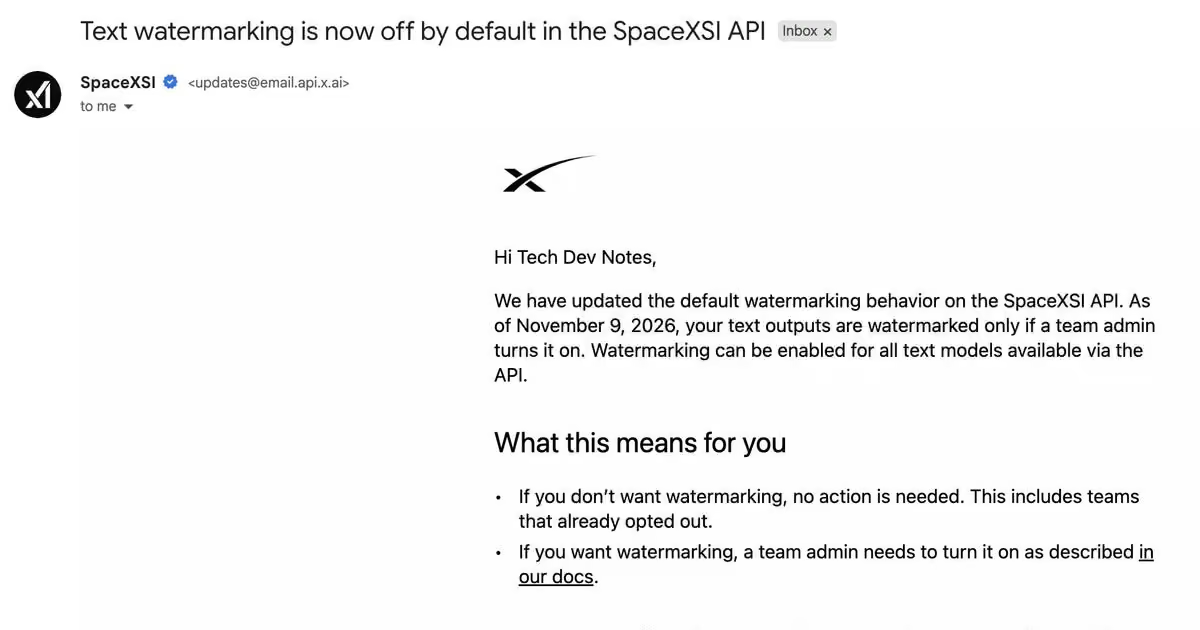
By November 9 or 10 the default had flipped. Team admins now had to turn the feature on deliberately through the console. A customer email confirmed outputs stay unmarked unless someone enables it. Documentation updated quietly with no big announcement explaining the change of heart.
Elon Musk settled the remaining questions on November 14. "Text watermarking with Grok is only on where required by law or requested by the user," he posted. The note landed while quoting a developer screenshot of the new off-by-default status.
That stance leaves the legal duty mostly with deployers in places that demand labeling. Readers cannot easily verify the mark themselves. Paraphrasing can weaken statistical signals anyway. Other labs take different paths. Some apply marks worldwide with no opt-out. Others limit them to specific regions or keep them opt-in from the start.
WHY THE SWITCH MATTERS
Invisible watermarks aim to help platforms and researchers track AI-generated prose without wrecking readability. Forced defaults raise pushback from builders who want clean outputs for creative or commercial work. Memes, rapid iteration, and agent chains suffer if every response carries a detectable signature by design.
SpaceXSI still supports the capability. Admins can activate it model by model when local rules or customer contracts require it. Consumer Grok chats and the Imagine image/video tools sit outside this API policy. Images and videos already carry a visible Grok mark that stays on.
The episode shows how fast AI providers adjust to both regulation and user feedback. A two-day default window gave the industry a live experiment in what happens when provenance tools meet real developer workflows. Musk's clarification locks in the current flexible approach for now.
Watch for how the December EU deadline plays out across providers and whether more jurisdictions push similar transparency rules. For Grok users and API customers the practical result is simple: unmarked text remains the everyday default unless someone actively chooses otherwise.
0 COMMENTS